A structured approach to problem solving
Problem solving is a skill you can learn. A structured, seven-step approach for working through hard problems.
A structured approach to problem solving
Hard problems get easier when you stop attacking them all at once and work through them in order. The seven-step flow below is a well-established approach to structured problem-solving — Charles Conn and Robert McLean lay it out in detail in their book Bulletproof Problem Solving.
- Define the problem — what exactly do we need to figure out, and why does it matter?
- Structure it and generate ideas — break the problem into parts and ask what could be driving it.
- Prioritise the issues — which parts matter most?
- Plan the analysis — where should we spend our limited time?
- Do the analysis — what are we trying to prove or disprove?
- Synthesise the findings — what do the results actually mean? Ask “so what?”
- Make recommendations — what should we do next?
1. Define the problem
Resist the urge to judge quickly from gut feel or under pressure. Get specific about what you’re solving before you start solving it.
Run a SMART check
A useful discipline here is to make sure your problem statement is SMART — Specific, Measurable, Actionable, Relevant, and Time-bound. A SMART statement is clear and focused, which makes the problem far easier to actually solve.
- Specific — what exactly needs to be solved?
- Measurable — how will we know when it’s solved?
- Actionable — what can we actually do about it?
- Relevant — why does solving this matter?
- Time-bound — by when does it need to be solved?
2. Structure the problem and generate ideas
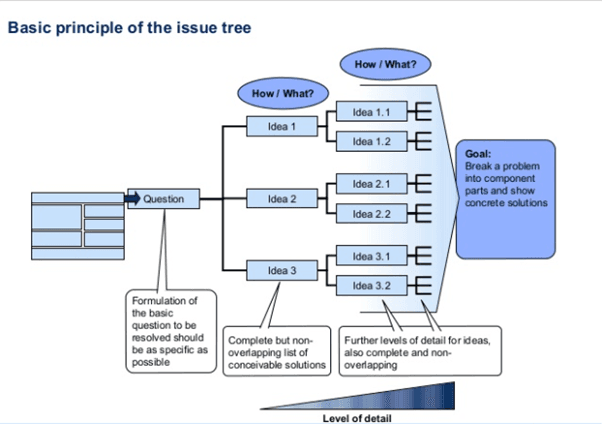
A logic tree (also called an issue tree) is the tool for this: it breaks a problem into smaller, manageable parts and lays them out visually so you can see the key drivers.
3. Prioritise the issues
Once the problem is broken down, focus on what counts. Not all issues carry equal weight, and your time is limited.
The Pareto principle (the 80/20 rule) is a helpful lens: for many outcomes, roughly 80% of the consequences come from about 20% of the causes. Find that 20%.
A prioritisation matrix helps when several things all feel urgent. Plotting each issue by importance and urgency — this is the classic Eisenhower Matrix — sorts them into clear actions:
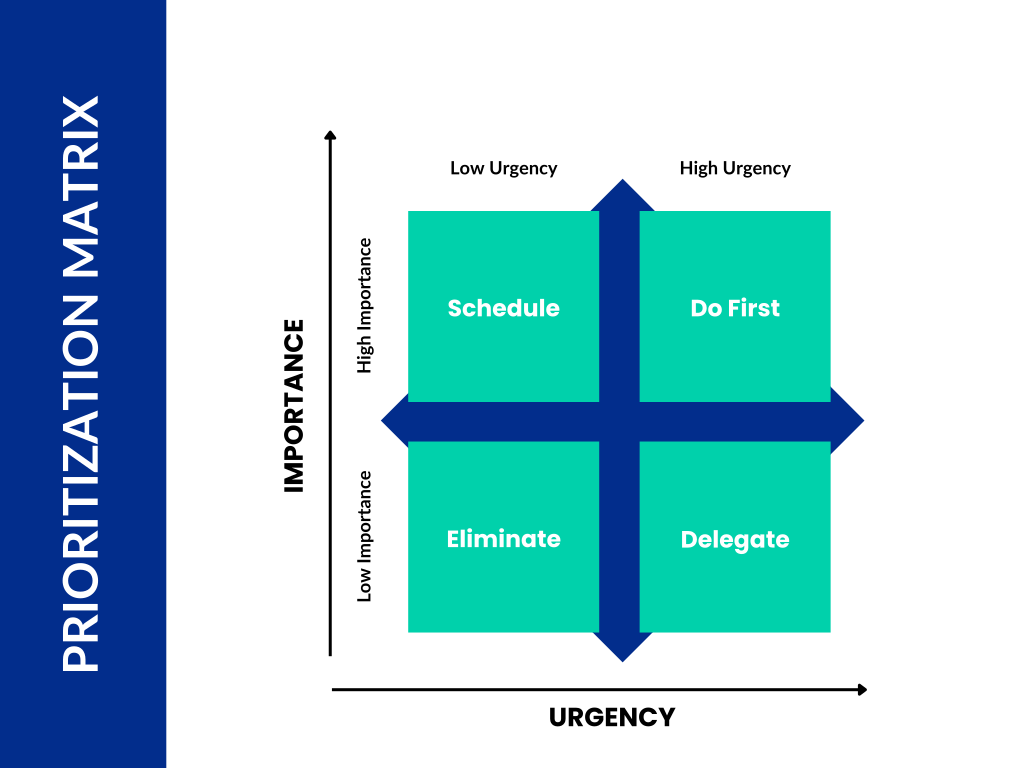
- Important + urgent → do it now
- Important + not urgent → schedule it
- Not important + urgent → delegate it
- Not important + not urgent → drop it
4. Plan the analysis
Before diving in, be clear on what evidence would confirm or reject each hypothesis, and which specific analyses will produce that evidence. This keeps you from burning time on analysis that won’t actually move the decision.
5. Do the analysis
Some findings will turn out wrong — that’s normal. Getting to a good solution is iterative: you’ll often loop back, take up the next-best hypothesis, and re-analyse. Treat it as a cycle of hypothesis → analysis → refinement, not a straight line.
6. Synthesise the findings
Synthesis is not the same as a summary. A summary just recaps what you did; synthesis combines your findings into a new understanding — the actual “so what.” Present it logically and clearly enough that someone can follow your reasoning to the same conclusion.
7. Make recommendations
Recommendations are the concrete actions that will create value or deliver the impact you set out to achieve. Once you have them, align your organisation and assign a team to execute.
Finally, make sure your findings are debiased. Checking your conclusions for cognitive bias keeps the analysis fair and genuinely useful, rather than just another answer produced for the sake of having one.
Reference
- Charles Conn & Robert McLean, Bulletproof Problem Solving: The One Skill That Changes Everything (Wiley).