Problem Solving
Problem solving is a skill that can be learned and improved over time. A structured seven-step framework to master it.
The Problem-Solving Framework
-
Define the problem: Think impact - what do we need to know?
-
Structure the problem and Generate Ideas: Break down the problem into smaller, manageable parts. Ask what could be the key drivers of the problem?
-
Prioritize Issues: What are the most important issues to address?
-
Plan analyses and work: Where and how should we spend our time efficiently?
-
Conduct Analysis: What are we trying to prove/disprove?
-
Synthesize findings: Think what implications do our findings have? Ask “so what”
-
Developer recommendations: What should we do next?
1. Define the problem
Don’t make quick judgements based on gut feelings or when you are under pressure. Break down the problem into smaller, manageable parts. Ask what could be the key drivers of the problem?
1.1 SMARTness check
SMART is the acronym for Specific, Measurable, Actionable, Relevant, and Time-bound. Ensuring your problem statement is SMART will help you make it more clear and focused, which in turn helps to solve it more efficiently.
- Specific - What exactly needs to be solved?
- Measurable - How will we know when the problem is solved?
- Actionable - What can we do to solve the problem?
- Relevant - Why is this problem important to solve?
- Time-bound - When does the problem need to be solved by?
2. Structure the problem and generate ideas
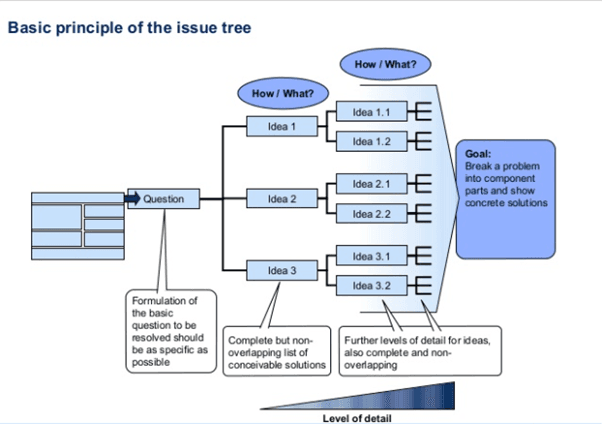
Logic tree (also called Issue tree) is a tool to break down a problem into smaller, manageable parts. It is a visual representation of the problem and helps to identify the key drivers of the problem.
3. Priotize the issues
Once the problem is broken down into smaller, manageable parts, it is important to prioritize the issues to address. Not all issues are equally important, and it is important to focus on the issues that will have the biggest impact.
Pareto principle or the 80/20 rule is a useful concept for this stage, which states that for many outcomes, roughly 80% of consequences come from 20% of the causes.
Prioritization matrix is another approach which also helps to prioritize the issues wisely. It comes handy when you feels multiple things are a top priority to be solved.
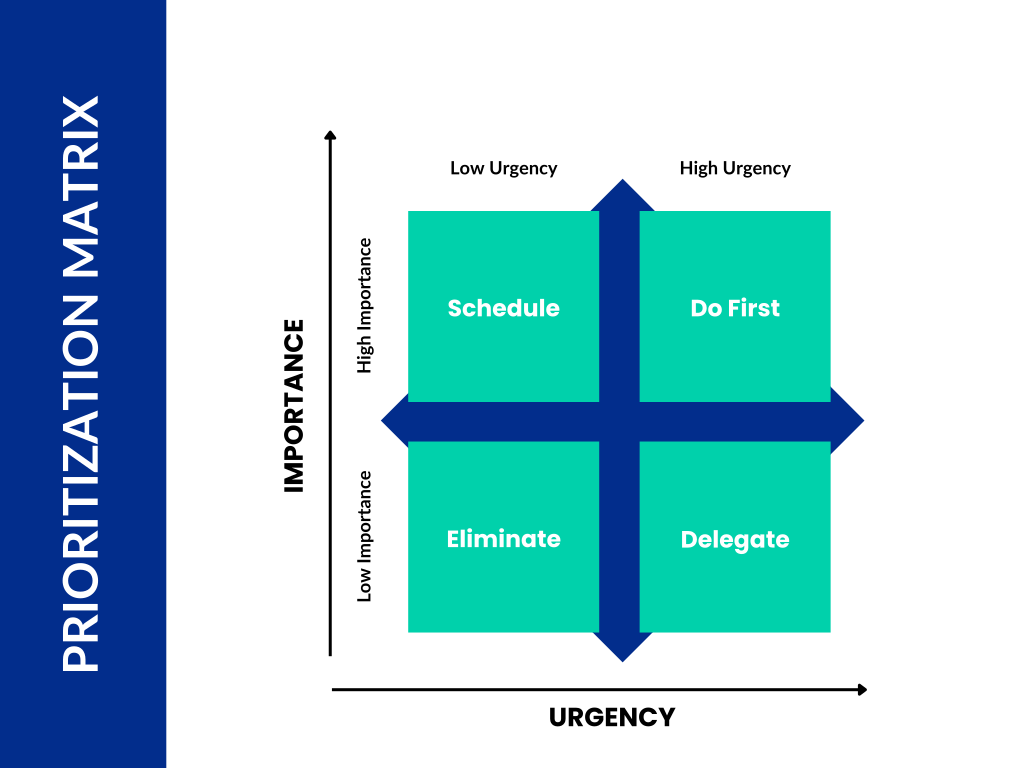
- High Important, High Urgent = Do it now
- High Important, Low Urgent = Schedule it
- Low Important, High Urgent = Delegate it
- Low Important, Low Urgent = Eliminate it
4. Plan analysis and work
Before this step, have a clear picture on what all proof are needed to accept or reject the hypothesis. And which analysis you need to conduct to prove or disprove the hypothesis.
5. Conduct analysis
Certain findings can be wrong. Getting to the solution is an iterative process which can be improved constantly. In this stage, you might need to go back and forth with next best hypothesis and analysis to solution.
Work planning is a process of planning the analysis to be done in order to solve the problem.
6. Synthesize findings
Synthesis is the process of combining different ideas or information to form a new idea or understanding, which is often misinterpreted as summary. Summary is just the overview of what you have done.
Synthesis is the outcome of your analysis and it should be presented in a way that is easy to understand. It should be logical and well-structured, and it should be easy to follow.
7. Develop recommendations
Recommendations are what you should do in order to create value or to achieve the impact of the work. Next, make your organization to align and assign the team to execute the recommendations.
Ensuring your findings to be (debiased)[/learning/debiasing] is very important. This helps to keep your analysis to be fair, right, and not just yet another answer to the analysis, which often did by many just for the sake of it.
Reference: